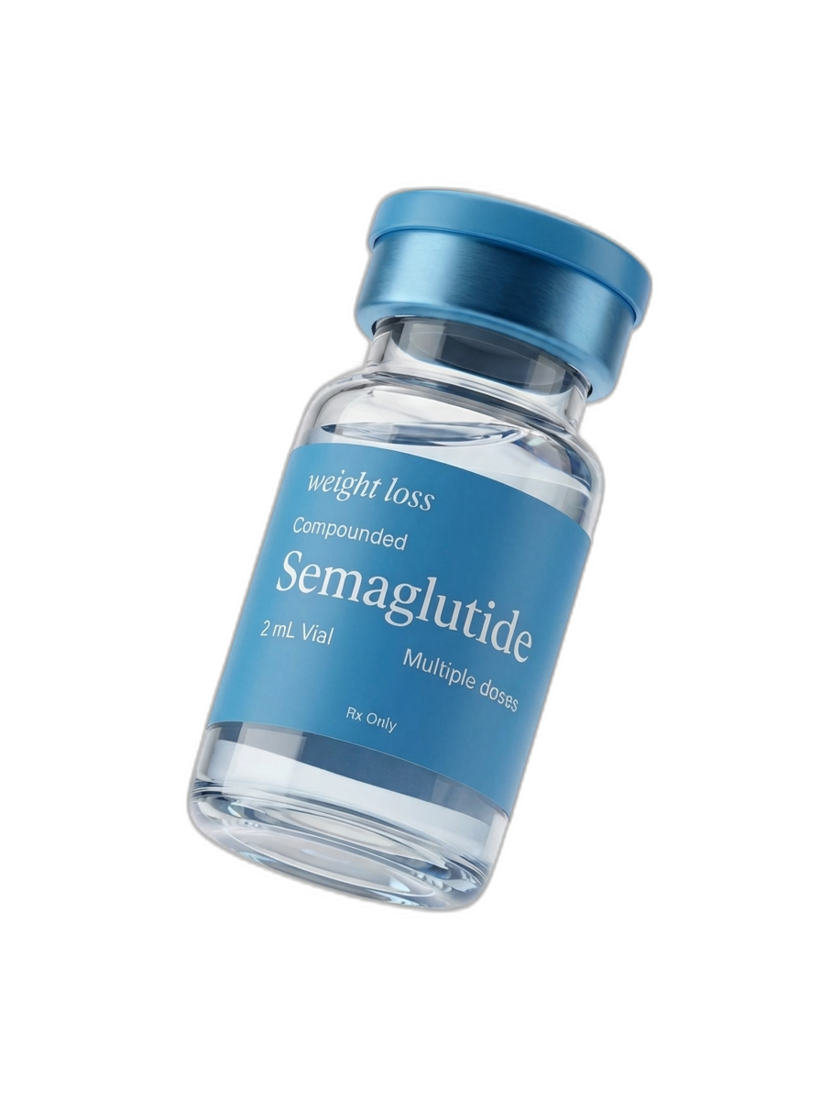
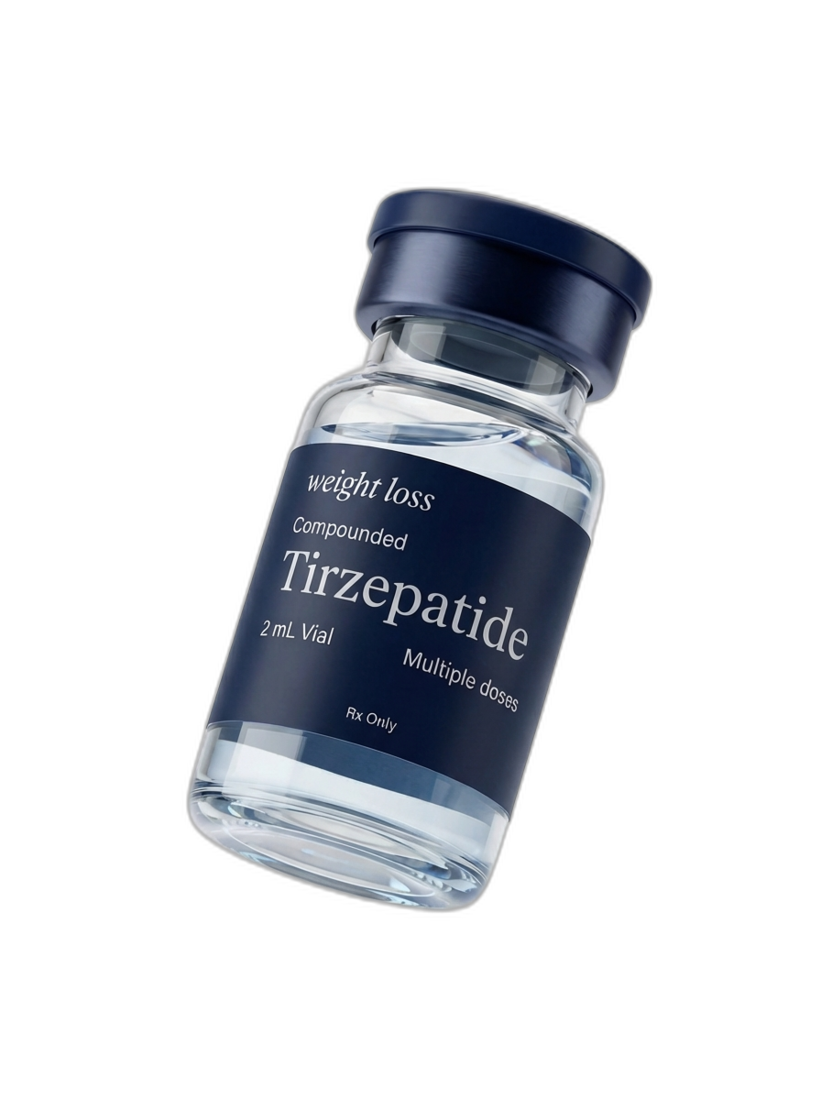
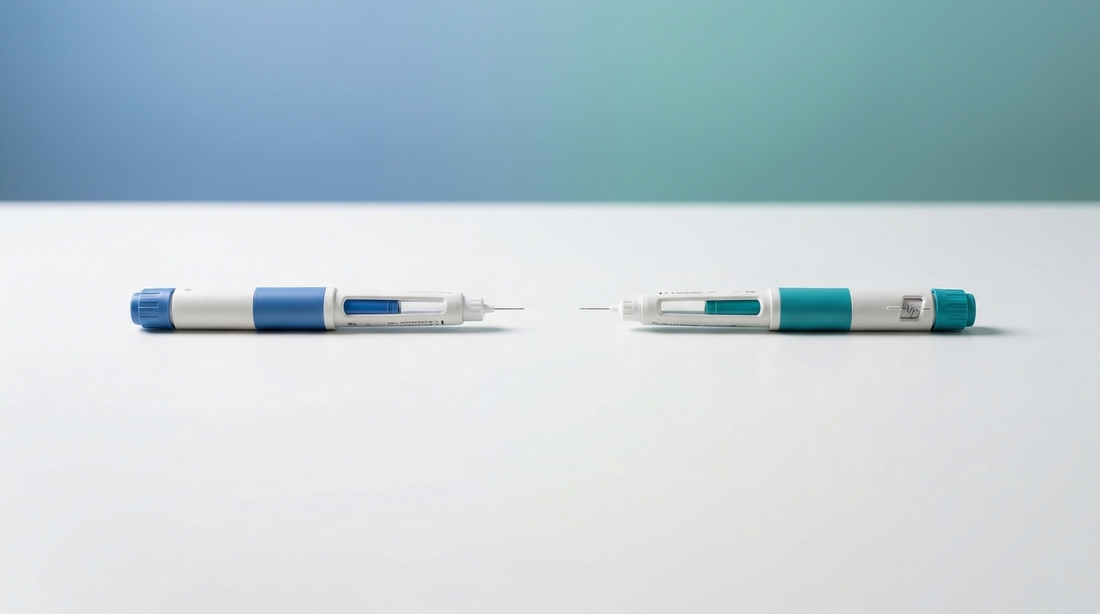
- Both semaglutide and tirzepatide are GLP-1 receptor agonists, but tirzepatide is a dual agonist that also targets GIP receptors, giving it a second metabolic pathway to work with.
- Clinical trials show tirzepatide produces greater average weight loss: 22.5% at the highest dose versus 14.9% for semaglutide, though no direct head-to-head trial exists yet.
- Tirzepatide appears to have lower rates of nausea (33.3% vs. 44.2%) and vomiting (12.2% vs. 24.8%) based on trial data, though both share a similar overall side effect profile.
- Semaglutide has an older, larger safety record and the only published cardiovascular outcomes trial showing a 20% reduction in major cardiac events (SELECT, 2023).
- Both are available as compounded versions, which significantly reduces cost compared to brand-name Wegovy or Zepbound. The right choice depends on your goals, history, and provider's guidance.
What is the difference between semaglutide and tirzepatide?
Semaglutide targets GLP-1 receptors only. Tirzepatide targets both GLP-1 and GIP receptors simultaneously, making it a dual agonist. Both are once-weekly injections. Tirzepatide's additional GIP mechanism appears to amplify weight loss results beyond what GLP-1 activation alone can achieve.
When most people hear the names Ozempic, Wegovy, Mounjaro, or Zepbound, they know these medications are related to weight loss. What is less commonly understood is that these four drugs represent two distinct molecules with meaningfully different mechanisms.
Semaglutide, the molecule behind Ozempic and Wegovy, was developed by Novo Nordisk and first approved for type 2 diabetes in 2017. It works by mimicking GLP-1 (glucagon-like peptide-1), a gut hormone that regulates appetite, slows gastric emptying, and stimulates insulin release after meals. Engineered to resist the enzyme that normally breaks down GLP-1 within minutes, semaglutide stays active in the body for approximately seven days, making once-weekly dosing practical.[7]
Tirzepatide, the molecule behind Mounjaro and Zepbound, was developed by Eli Lilly and approved for type 2 diabetes in 2022. It is the first drug of its class to activate two different receptor pathways simultaneously: GLP-1 and GIP (glucose-dependent insulinotropic polypeptide). This dual action is why tirzepatide is referred to as a dual agonist. Its half-life of approximately five days also supports once-weekly dosing.[8]
Both medications reduce appetite, slow digestion, and improve blood sugar regulation. The practical question for most people is whether tirzepatide's added mechanism translates into meaningfully better outcomes, and what trade-offs come with each choice.
How they work: single vs. dual agonist
GLP-1 receptor activation
GLP-1 receptors are found throughout the body: in the brain, gut, pancreas, heart, and kidneys. When a GLP-1 receptor agonist binds to these receptors, several things happen in parallel. Appetite signals in the hypothalamus are suppressed, so the constant drive to eat quiets down. The stomach empties more slowly, extending the physical sensation of fullness after meals. The pancreas releases more insulin when blood sugar rises and less glucagon, which prevents the liver from releasing stored glucose when it does not need to.[7]
This three-part mechanism is what makes GLP-1 medications so much more effective than older appetite suppressants, which typically targeted only one pathway. Semaglutide exploits all three of these GLP-1 pathways simultaneously.
GIP receptor activation: tirzepatide's second gear
GIP (glucose-dependent insulinotropic polypeptide) is another incretin hormone released from the gut after eating. Like GLP-1, it stimulates insulin secretion. But GIP also acts on fat cells directly, affecting how the body stores and burns fat. GIP receptors in the brain may also contribute to appetite regulation, though through different circuits than GLP-1.
For years, researchers believed that GIP receptor activation would actually work against weight loss, because GIP's effect on fat cells seemed to promote fat storage in some models. Tirzepatide proved that assumption wrong. A 2022 analysis in The Lancet Diabetes and Endocrinology by Nauck and D'Alessio explained that the co-agonism of GLP-1 and GIP may produce complementary, additive effects that neither receptor produces alone.[8]
The result in clinical practice: people on tirzepatide lose more weight on average than people on semaglutide, even when controlling for dose and treatment duration.
Weight loss results: head to head
The clearest way to compare these two medications is through their landmark clinical trials. It is important to note that no direct head-to-head randomized controlled trial specifically comparing semaglutide and tirzepatide for weight loss has been published as of 2026. The SURMOUNT-5 trial is currently underway. The comparisons below are drawn from separate trials that used similar populations but were not designed as direct comparisons.
The STEP trials: semaglutide's clinical foundation
The STEP program (Semaglutide Treatment Effect in People with Obesity) was a series of randomized, placebo-controlled trials that established semaglutide 2.4mg as a weight management treatment. STEP 1, published in the New England Journal of Medicine in 2021, enrolled 1,961 adults with obesity or overweight and found that participants on semaglutide lost an average of 14.9% of their body weight over 68 weeks, compared to 2.4% on placebo.[1]
More than one-third of semaglutide participants lost 20% or more of their body weight. STEP 2 extended the findings to people with type 2 diabetes, where average weight loss was 9.6%.[9] STEP 3 showed that combining semaglutide with intensive behavioral therapy produced 16% average weight loss.[11]
The STEP trials also confirmed a critical point about long-term use. STEP 4, published in JAMA, showed that participants who stopped semaglutide after 20 weeks of treatment regained approximately two-thirds of their lost weight within 52 weeks, while those who continued maintained their results.[14]
SURMOUNT-1: tirzepatide raises the benchmark
SURMOUNT-1, published in the New England Journal of Medicine in 2022, enrolled 2,539 adults without diabetes across four dose groups (5mg, 10mg, 15mg, and placebo).[2] At the highest dose of 15mg, participants lost an average of 22.5% of body weight over 72 weeks. The study authors described this as weight loss "not previously achieved with pharmacological intervention." Forty percent of participants at the 15mg dose lost 25% or more of their body weight.
SURMOUNT-2 extended the findings to people with type 2 diabetes, where tirzepatide produced 14.7% average weight loss, which itself exceeded semaglutide's results in the diabetic population.[3]
"Weight reductions of this magnitude have not previously been achieved with pharmacological intervention for the treatment of obesity." -- SURMOUNT-1 investigators, NEJM 2022
Cardiovascular data: semaglutide has the edge so far
The SELECT trial, published in the New England Journal of Medicine in 2023, was a landmark 17,604-person trial of semaglutide in people with overweight or obesity and established cardiovascular disease but no diabetes.[4] Participants on semaglutide had a 20% lower rate of major cardiovascular events compared to placebo, independent of the amount of weight they lost. This was the first large trial to show a weight loss medication directly protects the heart in people without diabetes.
Tirzepatide's cardiovascular outcomes trial (SURPASS-CVOT) is ongoing, and results are pending. Until that data is published, semaglutide holds a meaningful advantage for patients whose cardiovascular risk is a primary concern.
Side effects compared
Both medications share a similar side effect profile. The most common effects are gastrointestinal: nausea, vomiting, diarrhea, and constipation. These occur primarily during dose escalation and typically improve over time. Serious adverse events are rare for both.
Where tirzepatide appears to have an advantage is in the frequency of nausea and vomiting. Trial data shows:
| Side Effect | Semaglutide (STEP 1) | Tirzepatide (SURMOUNT-1) |
|---|---|---|
| Nausea | 44.2% | 33.3% |
| Vomiting | 24.8% | 12.2% |
| Diarrhea | 29.7% | 22.1% |
| Constipation | 24.2% | 17.6% |
| Discontinued due to side effects | 4.5% | 4.3% |
These differences are meaningful but should be interpreted with care. The trials used different populations, dosing timelines, and protocols. The lower nausea rate for tirzepatide may be partly explained by its different molecular structure and slightly slower receptor activation profile, but a direct controlled comparison has not been published.
Both medications carry similar contraindications. They are not recommended for people with a personal or family history of medullary thyroid carcinoma or multiple endocrine neoplasia syndrome type 2. Pancreatitis occurred at similar rates in treatment and placebo groups across major trials. A thorough medical history review before starting either medication is essential.
Not sure which medication is right for your situation?
Take our free 2-minute quiz. A licensed provider reviews your answers personally and recommends a plan built for you.
Take the Free Quiz →Cost and availability
Brand-name pricing
Without insurance, brand-name GLP-1 medications are expensive. Wegovy (semaglutide 2.4mg) has a list price of approximately $1,349 per month. Zepbound (tirzepatide for weight management) launched at a slightly lower list price of approximately $1,060 per month, a strategic move by Eli Lilly to gain market share against Wegovy. Actual out-of-pocket cost varies based on insurance, copay programs, and manufacturer savings cards.
Insurance coverage for weight management indications remains limited. Many plans cover the diabetes versions (Ozempic, Mounjaro) more readily than the weight-loss versions (Wegovy, Zepbound), even when prescribed for the same molecule at a different dose.
Compounded options: a more accessible path
Both semaglutide and tirzepatide are available as compounded medications prepared by licensed U.S. compounding pharmacies with a valid physician prescription. Compounded GLP-1 medications are not FDA-approved but are prepared under state pharmacy board oversight. They offer a significantly lower price point, often in the range of $150 to $400 per month depending on dose and pharmacy, making them accessible to patients who cannot afford or cannot obtain brand-name coverage.
Kind MD works with licensed U.S. compounding pharmacies to provide both options. The availability of compounded forms can also shift during periods when brand-name products face supply shortages, as occurred with Ozempic and Wegovy in 2023 and 2024.
FDA approval and brand names
Understanding the relationship between the molecule and its brand names helps clarify what you are actually getting when you see different product names in the market.
| Brand Name | Molecule | Indication | FDA Approval |
|---|---|---|---|
| Ozempic | Semaglutide (0.5mg, 1mg, 2mg) | Type 2 diabetes management | December 2017 |
| Rybelsus | Semaglutide (oral, 3mg, 7mg, 14mg) | Type 2 diabetes management | September 2019 |
| Wegovy | Semaglutide (2.4mg) | Chronic weight management | June 2021 |
| Mounjaro | Tirzepatide (2.5mg to 15mg) | Type 2 diabetes management | May 2022 |
| Zepbound | Tirzepatide (2.5mg to 15mg) | Chronic weight management | November 2023 |
Rybelsus is the only oral GLP-1 medication in this family. It uses the same semaglutide molecule but in a pill formulation taken daily. Its weight loss outcomes in published trials are lower than the injectable version, likely due to differences in bioavailability.[5]
One important nuance: Ozempic and Mounjaro are their respective molecules at doses approved for diabetes. Wegovy and Zepbound are the same molecules at higher doses approved specifically for weight management. Physicians frequently prescribe the diabetes-labeled versions off-label for weight loss, particularly when insurance coverage is more favorable.
Which one should you choose?
This is not a decision that should be made based on a comparison article alone. It requires a real conversation with a licensed provider who can review your full medical history. That said, here is a framework for thinking through the relevant factors.
Tirzepatide may be a stronger fit if
- Your primary goal is maximizing weight loss and you want the highest-performing option based on current trial data
- You have struggled with nausea on GLP-1 medications before and want to minimize that risk
- Your diabetes management is the primary concern and you want superior A1C reduction (Mounjaro showed greater A1C lowering than Ozempic in SURPASS head-to-head trials)
- Cost is a factor and you can access Zepbound at its lower list price relative to Wegovy
Semaglutide may be a stronger fit if
- Cardiovascular risk reduction is a priority and you want a medication with published outcomes data showing direct heart protection (SELECT trial)
- You have a longer-standing condition and prefer the medication with the larger published safety track record and longer post-market history
- Your insurance covers Wegovy but not Zepbound
- You prefer an oral option and want to try Rybelsus before committing to injections
Factors that matter equally for both
- Prior GLP-1 experience and how well you tolerated it
- Thyroid cancer history or family history (contraindication for both)
- Pancreatitis history (precaution for both)
- Your baseline weight, target weight, and realistic timeline expectations
- Your ability to commit to lifestyle factors like adequate protein intake and consistent activity
The most important thing is starting. Both medications produce meaningful, clinically significant weight loss results that are far beyond what diet and exercise alone typically achieve in people with obesity. The difference between semaglutide and tirzepatide is real, but the difference between either medication and doing nothing is far larger.
Can you switch between them?
Yes. Switching from semaglutide to tirzepatide, or in the reverse direction, is common and can be done safely with provider guidance. There is no required washout period between these medications given their similar mechanisms and receptor activity, though your provider will determine the appropriate starting dose and timing for the transition.
Common reasons patients switch
- Insufficient weight loss response: Some patients plateau on semaglutide and want to try tirzepatide's dual mechanism to continue progress
- Persistent side effects: Patients who experience significant nausea on semaglutide sometimes tolerate tirzepatide better, and vice versa
- Insurance or cost changes: Coverage shifts are a practical reality, and switching to the covered option is common
- Supply availability: Shortages of one molecule can make switching to the other a practical decision
- New cardiovascular data: As tirzepatide's outcomes trials complete, some patients may switch based on new evidence
When switching, your provider will typically start you at a low or moderate dose of the new medication rather than jumping directly to the equivalent dose. The two molecules have different receptor profiles, and how your body responds to one does not perfectly predict how it will respond to the other. A conservative restart allows your provider to monitor tolerance and adjust accordingly.
Semaglutide vs. tirzepatide: the complete comparison
| Feature | Semaglutide | Tirzepatide |
|---|---|---|
| Mechanism | GLP-1 receptor agonist | GLP-1 + GIP dual agonist |
| Brand names (weight loss) | Wegovy | Zepbound |
| Brand names (diabetes) | Ozempic, Rybelsus | Mounjaro |
| Average weight loss | 14.9% (STEP 1) | 22.5% (SURMOUNT-1, highest dose) |
| Dosing | Once weekly injection | Once weekly injection |
| Dose range | 0.25mg to 2.4mg | 2.5mg to 15mg |
| Nausea rate | 44.2% | 33.3% |
| Vomiting rate | 24.8% | 12.2% |
| FDA approved for weight loss | June 2021 | November 2023 |
| Brand cost per month | $1,300+ (Wegovy) | $1,060+ (Zepbound) |
| Compounded available | Yes | Yes |
| Cardiovascular outcomes data | Yes (SELECT trial: 20% reduction) | Pending (SURPASS-CVOT) |