Free expedited shipping on all orders
← Back to Blog
How-To

How to Inject Semaglutide: A Step-by-Step Visual Guide

By Kind MD Team | April 9, 2026 | 10 min read
Last reviewed: April 2026
Step-by-step guide to self-injecting semaglutide at home
KEY TAKEAWAYS
In This Article
  1. What you will need before you start
  2. Step-by-step injection process
  3. Choosing your injection site
  4. Injection sites compared
  5. Rotation schedule
  6. How to store semaglutide
  7. Common mistakes to avoid
  8. Tips for needle anxiety
  9. When to skip a dose
Quick Summary

Self-injecting compounded semaglutide takes less than 5 minutes from start to finish. The needle is very fine, the injection is subcutaneous (under the skin, not into muscle), and the process becomes second nature quickly. This guide walks you through every step so you feel completely prepared before your first injection.

One of the most common questions new Kind MD patients ask is: "Will I really be able to do this myself?" The short answer is yes, and it is easier than most people expect. The needles used for semaglutide are the same short, fine-gauge needles used for insulin. The injection goes into the fat just below your skin, not into muscle. With proper technique, most patients rate the discomfort as a 1 or 2 out of 10.

This guide is built around the exact process your Kind MD provider recommends. Follow it as written for your first few injections, and by your third or fourth dose you will have your own comfortable routine.

What you will need before you start

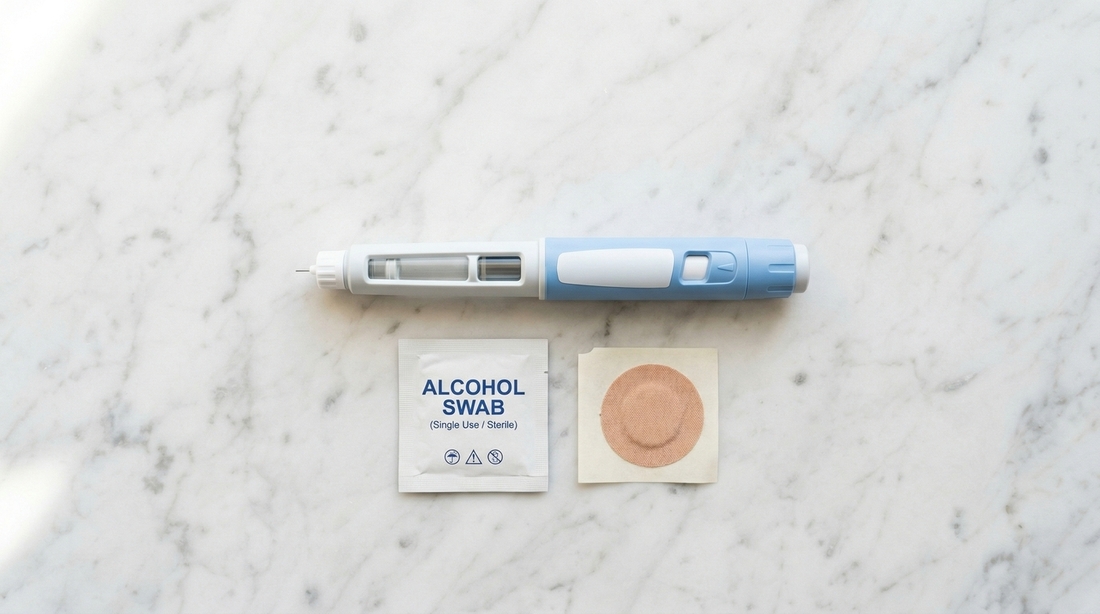
Gather everything before you begin so you are not searching for supplies mid-injection. You will need:

Remove your semaglutide vial from the refrigerator about 30 minutes before your injection. Injecting cold medication can cause more discomfort at the site. Room-temperature medication goes in more smoothly.

Before Every Injection

Check the expiration date on your vial. Inspect the solution: it should be clear and colorless. If you see particles, cloudiness, or any discoloration, do not use that vial. Contact your Kind MD provider or the dispensing pharmacy immediately.

Step-by-step injection process

Follow these eight steps in order every time you inject. The entire process takes 4 to 6 minutes once you are comfortable with it.

1

Wash your hands

Wash both hands thoroughly with soap and water for at least 20 seconds. Clean under your nails and between your fingers. Dry completely with a clean towel. This is the single most important step for preventing infection at the injection site.

2

Inspect the vial and gather supplies

Hold the vial up to a light source and confirm the solution is clear and free of particles. Check the label to confirm this is the correct medication and dose. Set out your syringe, alcohol swabs, and sharps container within easy reach.

3

Clean the vial stopper

Wipe the rubber stopper on the top of the vial with an alcohol swab using a single firm stroke. Let it air dry for 10 full seconds. Do not blow on it or fan it dry.

4

Draw your dose

Pull air into the syringe equal to your prescribed dose volume. Insert the needle straight down through the cleaned rubber stopper. Push the air into the vial, then turn the vial upside down. With the needle tip submerged in the liquid, slowly pull the plunger back to draw your prescribed volume. If you see a large air bubble, flick the syringe barrel and gently push the plunger to expel it. Small microbubbles are harmless. Withdraw the needle from the vial.

5

Choose and clean your injection site

Pick today's rotation site (see the rotation schedule below). Using a fresh alcohol swab, clean a 2-inch circle of skin at the chosen spot. Swab in one direction, not back and forth. Let it dry completely for 10 seconds before proceeding. Injecting through wet skin can sting and introduces moisture into the injection.

6

Pinch the skin and insert the needle

Using your non-dominant hand, pinch about 1 to 2 inches of skin between your thumb and forefinger. This lifts subcutaneous fat away from the muscle underneath. Hold the syringe like a pencil in your dominant hand. Insert the needle at a 45-degree angle if you have less subcutaneous fat, or 90 degrees if you have more. Push it in with a smooth, steady motion. Do not hesitate or go slowly at the insertion step: a quick, confident entry is more comfortable than a slow one.

7

Inject slowly and hold

Push the plunger down slowly and steadily over 5 to 10 seconds. Rushing this step is one of the most common causes of site discomfort. After the full dose is delivered, keep the needle in place and count to 10 before withdrawing. This dwell time gives the medication time to disperse and prevents it from tracking back out through the needle channel.

8

Withdraw and dispose safely

Withdraw the needle at the same angle it entered. Apply light pressure with a gauze pad or your finger if you notice any minor bleeding, but do not rub the site. Rubbing can cause bruising or push medication away from the intended tissue. Immediately drop the entire used syringe into your sharps container. Never recap a needle by hand.

Illustration of pinching skin and inserting semaglutide needle at 45 degree angle
Pinching the skin lifts subcutaneous fat off the muscle. Insert at 45 to 90 degrees depending on your body composition.

Choosing your injection site

Semaglutide is a subcutaneous injection, meaning it goes into the fatty tissue just below the skin. There are three approved sites, each with practical differences worth understanding.

Abdomen

The abdomen is the most frequently recommended site for first-time self-injectors. It is easy to see, easy to pinch, and tends to have reliable subcutaneous fat for most patients. Aim for the area at least 2 inches away from your navel in any direction. Avoid the area directly around any existing scars or stretch marks. Do not inject into the belt line, where movement from clothing can irritate the site.

Outer thigh

The outer thigh (the middle third of the outer surface between knee and hip) is an excellent choice, especially if you have abdominal soreness from a previous injection. It is easy to self-administer while seated. Avoid the inner thigh, where friction between the legs can cause irritation, and the area immediately behind the thigh.

Upper arm

The back of the upper arm (the tricep area) is an approved site but is harder to reach solo. Pre-filled auto-injector pen formulations make this easier; with a vial-and-syringe method, most patients find the arm impractical without a second person to assist. If you want to use your arm and are using a vial, ask your provider whether a pen device is an option.

Injection sites compared

Site Ease of Self-Injection Typical Pain Level Absorption Rate Best For
Abdomen Easiest Low (1-2/10) Fastest and most consistent First-time injectors, daily routine
Outer Thigh Easy Low to moderate (1-3/10) Slightly slower than abdomen Rotation from abdomen, seated injection
Upper Arm Difficult solo Low (1-2/10) with help Comparable to thigh With assistance, or pen formulations

Absorption rates across sites are clinically similar for semaglutide, though research on liraglutide (a shorter-acting GLP-1) suggests abdominal injections may produce slightly more predictable peak plasma levels.[6] For practical purposes, consistency in technique and rotation matter more than site selection.

Rotation schedule

Injecting the same spot repeatedly causes lipohypertrophy, a hardening and thickening of the fat tissue. Aside from being uncomfortable, these areas absorb medication unpredictably, which can affect how well your dose works.

A simple rotation system:

Most providers recommend staying at least one inch away from any previous injection site to give the tissue time to recover. If you notice a lump, hardness, or dimple forming at any site, avoid that area until it fully resolves and mention it at your next provider check-in.

Diagram showing injection site rotation zones on the abdomen and thigh
Rotating sites across quadrants prevents lipohypertrophy and keeps absorption consistent.

How to store semaglutide

Proper storage protects the medication's potency. Semaglutide that has been exposed to excessive heat, freezing, or prolonged light exposure may lose effectiveness even if it looks unchanged.

Before first use

Store unopened vials in the refrigerator at 36 to 46 degrees Fahrenheit (2 to 8 degrees Celsius). Keep them in their original packaging away from the back of the refrigerator where freezing can occur near the cooling element. Never freeze semaglutide. Frozen medication should be discarded.

After first use

Once you have drawn your first dose from a vial, compounded semaglutide is typically stable at room temperature (below 77 degrees Fahrenheit or 25 degrees Celsius) for up to 28 days. Keep it away from heat sources, sunny windowsills, and cars. Always check your pharmacy's label, as specific formulations may have slightly different guidance.

Traveling with semaglutide

A small insulated travel case with an ice pack is ideal for transport. Avoid leaving medication in a checked bag on flights (cargo holds can freeze). TSA permits injectable medications in carry-on luggage; bring a copy of your prescription label for security. Once you arrive, get the vial back into refrigeration within 8 hours if possible.

Not sure if you are ready to start? A Kind MD provider reviews every patient personally before prescribing.

Free assessment. No commitment.

Take the 2-Minute Quiz →

Common mistakes to avoid

Most injection problems come from a handful of avoidable errors. Knowing what to watch for makes a significant difference in your experience and results.

Tips for needle anxiety

Fear of needles is very common. A 2020 survey published in Vaccine estimated that roughly 25% of adults have some degree of needle phobia.[15] If you feel anxious before your first injection, you are not alone, and it does not make you a bad candidate for treatment. Here is what helps:

Understand what kind of needle this is

Insulin needles are among the smallest needles in clinical use. At 31 to 32 gauge, the needle is thinner than a strand of hair. It is not the needle used for blood draws or vaccinations. Many patients who expected the worst describe their first injection as anticlimactic.

Do not look if it helps

There is no clinical reason you need to watch the needle enter your skin. Some patients look away completely, others prefer to watch to feel in control. Do whatever reduces your anxiety. Neither approach changes the quality or safety of the injection.

Breathe out as you insert

Take a slow breath in, then exhale steadily as you insert the needle. Exhaling reduces muscle tension and can reduce the sharpness of the pinch sensation.

Cold and distraction

Applying an ice cube to the site for 30 to 60 seconds before injecting can numb the skin slightly. Watching a video or listening to something engaging during the injection also helps redirect attention.

Practice makes routine

Anxiety tends to drop sharply after the second or third injection. Most patients report that by their second week, the process feels entirely routine. Give yourself permission to be anxious for the first few doses and trust that it becomes easier.

"I put it off for two weeks because I was so afraid. By the third injection I was doing it in the car before work without thinking about it."

When to skip a dose

Semaglutide is typically prescribed as a once-weekly injection. Timing matters, but the schedule is forgiving within a window.

The FDA prescribing information for semaglutide states that if a dose is missed, it may be administered within 5 days of the scheduled dose. If more than 5 days have passed since the missed dose, skip it and resume your regular weekly schedule on the next scheduled day. Never double up to compensate for a missed dose.[1]

If you need to change your injection day permanently (for example, shifting from Sunday to Wednesday), you can do so as long as your new schedule maintains at least 2 days between doses during the transition week. Your Kind MD provider can walk you through this adjustment.

When to contact your provider before injecting


Medically reviewed This article was reviewed for clinical accuracy by licensed healthcare providers at Kind MD. Last reviewed April 2026.

Frequently asked questions

Does injecting semaglutide hurt?

Most people describe it as a small pinch or slight pressure, not real pain. The needles used are very fine (31 to 32 gauge, about the width of a hair). Letting the medication warm to room temperature, injecting slowly, and rotating sites all reduce discomfort. Many patients say it bothers them less than a finger-stick blood test.

Where is the best injection site for semaglutide?

The abdomen is the most commonly recommended site because it is easy to reach, easy to pinch, and has reliable absorption. Aim for the area at least 2 inches from your navel. The outer thigh is a reliable second choice. Upper arm injections work but are harder to self-administer without assistance.

Can I inject semaglutide in my arm by myself?

It is possible but more difficult to do alone. Pre-filled auto-injector pens make arm injections easier. With a vial-and-syringe approach, most patients find the abdomen or thigh much easier to manage without help. If you strongly prefer the arm, ask your provider whether a pen formulation is available for you.

How do I store semaglutide?

Unopened vials should be refrigerated at 36 to 46 degrees Fahrenheit (2 to 8 degrees Celsius). Once opened, compounded semaglutide is typically stable at room temperature (up to 77 degrees Fahrenheit or 25 degrees Celsius) for up to 28 days. Keep it away from heat, direct sunlight, and freezing. Always check your pharmacy's label for product-specific storage instructions.

What if I see a bubble in the syringe?

Small microbubbles are harmless in a subcutaneous injection. If you see a large visible air bubble, hold the syringe needle-up, tap the barrel gently, and push the plunger slightly to expel the bubble before injecting. You do not need to worry about air embolism with subcutaneous injections the way you would with IV injections.

What do I do if I miss a dose?

If you missed your scheduled weekly dose and it has been fewer than 5 days, inject as soon as you remember. If it has been 5 or more days, skip the missed dose and return to your regular injection day. Never inject two doses at once to make up for a missed one.

How do I dispose of used needles safely?

Place used needles immediately into an FDA-cleared sharps disposal container. Do not recap needles by hand, throw loose needles in household trash, or flush them. When the container is about three-quarters full, seal it and follow your local pharmacy or municipality guidelines for sharps disposal. Many pharmacies accept full sharps containers.

What should I do if I see redness or a lump at the injection site?

Mild redness, bruising, or slight swelling is common and usually resolves within 24 to 72 hours. Rotating sites with every injection significantly reduces this. If you notice persistent pain, significant swelling, warmth, or hardness for more than a few days, contact your Kind MD provider. These could indicate lipohypertrophy from repeated injections in the same spot, which is managed simply by avoiding that area for several weeks.

References

  1. U.S. Food and Drug Administration. "Ozempic (semaglutide) injection Prescribing Information." Revised January 2023. fda.gov
  2. U.S. Food and Drug Administration. "Wegovy (semaglutide) injection Prescribing Information." Revised March 2023. fda.gov
  3. Wilding JPH et al. "Once-Weekly Semaglutide in Adults with Overweight or Obesity." N Engl J Med. 2021;384(11):989-1002.
  4. Marso SP et al. "Semaglutide and Cardiovascular Outcomes in Patients with Type 2 Diabetes." N Engl J Med. 2016;375(19):1834-1844.
  5. American Diabetes Association. "Insulin Injection Technique." Standards of Medical Care in Diabetes. 2023.
  6. Frid AH et al. "New Insulin Delivery Recommendations." Mayo Clin Proc. 2016;91(9):1231-1255. (Injection site absorption and technique)
  7. Kreider KE, Lien LF. "Transitioning safely through periods of insulin therapy." Nurs Clin North Am. 2017;52(4):617-633.
  8. Novo Nordisk. "Semaglutide Storage and Handling." Product Information Sheet. 2022.
  9. De Cassai A et al. "Subcutaneous Drug Delivery." Clin Drug Investig. 2021;41(7):597-606. (Subcutaneous anatomy and technique)
  10. Hauner H et al. "Lipohypertrophy: Avoidance and management." Diabetes Technol Ther. 2016;18(S3):S75-S80.
  11. Gentile S et al. "Insulin injection technique and its impact on blood glucose control." Diabetes Ther. 2016;7(2):275-286.
  12. Strauss K et al. "Recommendations for the management of injection technique." Pract Diab. 2002;19(7 Suppl):S1-S4.
  13. Drucker DJ. "Mechanisms of Action and Therapeutic Application of Glucagon-like Peptide-1." Cell Metab. 2018;27(4):740-756.
  14. Blanco M et al. "Biological effect of injection depth in patients with type 2 diabetes." Diabetes Metab. 2013;39(5):445-453.
  15. McLenon J, Rogers MAM. "The fear of needles: A systematic review and meta-analysis." Vaccine. 2019;37(32):4421-4429.

Why trust Kind MD?

Kind MD articles are written by our content team and reviewed for clinical accuracy by licensed healthcare providers. We cite peer-reviewed research from journals like the New England Journal of Medicine, The Lancet, and JAMA, as well as FDA prescribing information and clinical guidelines. Our goal is to give you clear, honest information so you can make informed decisions about your health.

We are not your doctor. This content is for educational purposes only. Always consult with a licensed healthcare provider before starting any medication and follow your provider's specific instructions for your prescribed formulation. Questions? Reach us at care@kindmd.co.

Ready to start your treatment?

A licensed Kind MD provider reviews your intake personally. No commitment required to take the assessment.

Take the Free 2-Minute Quiz →